
Physiotherapy, Comedy, and Night-Shift Nursing — With a Camera Somewhere in the Middle
People imagine I turn up, click a button, and leave. What actually happens is closer to physiotherapy, comedy, and night-shift nursing — with a camera somewhere in the middle of it.
People imagine newborn photography looks like this: I arrive, I take some pictures of a sleeping baby, I leave. Simple.
Eighteen years in, I can tell you it is not that. Not even close.
Start with the equipment. Every session means carrying a full studio into someone's home — lighting, backdrops, wraps, props, all of it — up stairs, through narrow hallways, into houses that were never designed with a photographer's kit in mind. I've done this so many times now that I've given myself a frozen shoulder and a back that has strong opinions about certain movements. I've also, somewhere along the way, developed the arms of someone who lifts weights for a living. Nobody warns you about that part when you fall in love with newborn photography.
Then there's the baby. A newborn session doesn't run on my schedule, or the parents' schedule — it runs on a schedule that exists nowhere except inside a very small, very new person who has no interest in cooperating with anyone's plans. I've spent entire sessions holding a single pose, perfectly still, waiting for one genuine smile to cross a sleeping face. I've changed more nappies than I could count, rocked babies for what felt like hours, learned to read the tiniest pre-cry signals before they turn into an actual cry. People call me the baby whisperer, and I've come to accept it as an actual job requirement, not a compliment.
Older siblings need something entirely different from me — not patience with stillness, but the opposite. I turn into whatever kind of clown gets a shy five-year-old to trust me enough to be photographed looking like themselves, not like someone being told to smile for a camera. That relationship has to be built in minutes, not months.
And then there are the parents — often exhausted beyond words, running on almost no sleep, sometimes anxious in ways they can't quite name. Part of what I do in those hours has nothing to do with a camera at all. It's noticing things. I've caught small signs in a baby more times than I can count and gently flagged them — not as a doctor, but as someone who has now watched well over a thousand newborns closely enough to know when something is worth a second look.
By the time I leave, I'm usually exhausted and quietly thrilled, in that order. But the work isn't finished — it's barely begun. Every piece of fabric I brought gets washed before it touches another baby. Sneak peek images get edited that same day or the next, because I know parents are waiting, checking their phones, wanting one image before the full gallery arrives. Then the real editing starts — the long, unhurried part nobody sees, where a session slowly becomes the images you'll actually keep.
So when people picture newborn photography as "turn up, press a button, leave" — I understand why. From the outside, that's exactly what it looks like. From the inside, it's part physiotherapy, part comedy, part night-shift nursing, part quiet pattern-recognition — and somewhere in the middle of all of that, a camera.
I wouldn't trade it. But I thought you should know what it actually takes.
If you'd like to know more about how a session works, or see the full range of collections, everything is here →
Newborn Photographer in West Wickham
I've photographed one West Wickham family three times over — watching them grow from one baby to three, session by session, year by year.
Some families I only ever meet once. Others I get to watch grow — and as a newborn photographer in West Wickham for as long as I have been, I've had the privilege of both.
I first photographed a family in West Wickham in October 2013 — their first baby, that particular quiet of a first newborn session, everyone a little unsure of what to expect. I came back in January 2016 for their second. And again in September 2017, by which point there were three children filling the house instead of one.
Four years, three sessions, one family. I watched a couple become a family of five across the span of my own career — the kind of thing that only happens if you stay in this work long enough, and if families trust you enough to call you back.
That's the part of newborn photography that doesn't show up in a single gallery of images: the relationships that build slowly, session by session, as a family grows around you. I still remember details from that first 2013 session that I don't think I've ever written down — small things about how that first baby held her hands, the light in that particular room in October.
I photograph newborn and family sessions across West Wickham and the surrounding areas — often for families I'll get to know for years, not just for an afternoon.
I'd love to tell you more about how a session works, or you can see the full range of newborn collections and pricing here →
Newborn Photographer in Croydon
I circled Croydon three times before I found the right street. What happened once I got inside was worth every wrong turn.
I drove past a tall building in Croydon the other day and laughed to myself, remembering a winter session there a few years ago — the kind of memory that comes back whole, all at once, just from a building on the skyline. It reminded me how much I love working as a newborn photographer in Croydon, even when Croydon itself doesn't always make it easy.
Croydon's road system had other ideas about my arrival that day. I circled it three times before I found the right way in — one-way systems, junctions that don't quite go where you expect, a bit of muttering at the sat nav. By the time I actually reached the front door, I was fairly sure I'd seen most of Croydon from the car window.
But that's the part nobody remembers once the session starts. The baby was a few days old, the house was warm, and within minutes none of the driving mattered at all. That's usually how it goes — the getting there is never the story. The story is always what happens once I'm inside, camera down, waiting for a baby to settle into their own rhythm.
I photograph newborn sessions across Croydon and the surrounding areas, bringing full studio lighting, wraps, and eighteen years of knowing exactly how to hold a sleeping newborn — so you don't have to worry about anything except being there.
I'd love to tell you more about how a session works, or you can see the full range of newborn collections and pricing here →
Newborn Photographer in Petts Wood
One of my very first newborn sessions happened right here in Petts Wood — and all these years later, I still walk these same streets with my dogs most days.
As a newborn photographer in Petts Wood, I have a closer connection to this small stretch of London than to almost anywhere else I work. It's close enough to home that I walk my dogs here most days, past the same corners and gardens I've photographed dozens of families in over the years.
One of the very first newborn sessions I ever photographed was in Petts Wood — a baby girl, in a house I could probably still find blindfolded. Looking back, I'd say my career as a newborn photographer really began there, long before I had any sense of how many sessions would follow, or how many families across this small stretch of London I'd eventually come to know.
I've photographed so many newborns in Petts Wood since — enough that walking the same streets with my dogs now often means passing a house where I once sat quietly in someone's nursery, waiting for a baby to settle. It's a place that holds a lot of my history as a photographer, and I still love it as much as I did that very first time.
If you're expecting in Petts Wood or nearby, I'd love to be part of your early days too — bringing full studio equipment to your home, with eighteen years of experience behind me now instead of the handful I had back then.
I'd love to tell you more about how a session works, or you can see the full range of newborn collections and pricing here →
The First Year Package — Because This Is the Year That Changes Fastest
The year that changes fastest, recorded in full. Three sessions across your baby's first twelve months — newborn, milestone, and first birthday. Everything at home, everything unhurried.
The first year of a baby's life contains more change than any other. In twelve months, you go from a baby who fits in the crook of one arm and sleeps in twenty-minute stretches to a person who has opinions about food, pulls themselves up on the furniture, and may already be taking their first steps.
Most of that change goes unrecorded.
Not because parents don't want to record it — everyone wants to — but because the logistics of booking a photographer three separate times across a year that is already full and exhausting and wonderful feel like too much to think about when you're four weeks postpartum.
The First Year Package is the answer to that. One decision, made once, covers three sessions: the newborn session in those first quiet weeks, a milestone session at around six months when your baby is sitting and alert and beginning to show you who they are, and a first birthday session — which tends to be louder and more cake-involved than the other two.
All three happen at home. I come to you each time, with lighting and wraps and everything needed, so there's no travelling, no unfamiliar space, no logistical mountain to climb with a baby at different stages of mobility. The newborn session follows a baby who mostly sleeps. The milestone session follows a baby who is learning to sit. The first birthday session follows a baby who has views on everything and will make them known.
What you end up with is a complete record of the year — not just the newborn days, which tend to get photographed, but the in-between parts that don't. The six-month version of your baby, who already looks nothing like the newborn version. The almost-one-year version, who looks nothing like either.
The First Year Package is £1,400, which covers all three sessions and includes a fine art print from each. Full details on everything that's included here →
Sibling Newborn Photography — What If My Older One Won't Cooperate?
Every parent asks the same thing before a sibling session: what if my older one won't cooperate? Here's what eighteen years of experience has taught me about photographing children together.
Every parent asks some version of this question before a sibling session. Usually it comes in an email, slightly apologetic: "Just to warn you, my three-year-old is going through a phase." Or: "She says she doesn't want a baby brother, so this might be interesting." Or simply: "He won't sit still for more than thirty seconds."
Eighteen years in, I want to reassure you: this is not a problem. It is, in fact, almost exactly what I'm hoping for.
The sibling portraits that families treasure most are rarely the ones where everyone is sitting nicely and looking at the camera. They're the one where the older child is mid-lean, nose almost touching the baby's face, examining this new person with absolute seriousness. Or where they're holding the baby's hand with both of theirs, concentrating hard. Or where they've simply climbed in next to the baby and are looking at something completely else entirely, unaware of the camera at all.
Children between two and five years old are not good at performing. They are, however, often extraordinary at being themselves — and being themselves next to a new sibling produces some of the most honest portraits I make.
What I've learned is that the session works best when I don't try to control the older child too much. I give them a small job — "hold this," "sit here for a moment" — and then mostly I photograph what happens next. If they're interested in the baby, wonderful. If they lose interest after four minutes and want to go and find their toys, that's fine too. I've usually got what I need by then, and we can come back to it later when curiosity brings them back.
The one thing that does help is not building it up too much beforehand. Children who've been told for weeks that today is a very important day when they must be very good tend to arrive over-rehearsed and stilted. Children who've been told "a photographer is coming to take some pictures of the baby and you can be in them if you want" tend to arrive curious and relaxed.
If you're booking a newborn session and wondering whether to include your older child — include them. The images of the two of them together, from these very first days, are the ones you'll reach for first in twenty years.
Full details on newborn sessions here →
Mum and Baby Photography in London — The Session Most People Forget to Book
Just you and your baby. No posing props, no backdrops, no fuss. The session that exists for the part of early motherhood that usually goes unrecorded.
Most families book a newborn session for the baby. The poses, the wraps, the tiny curled feet. What often gets missed — and what I find myself thinking about more and more — is the other person in the room.
You, in those first weeks, are also someone worth photographing.
Mum and baby photography is a quieter thing than a full newborn session. There's no elaborate setup, no posing equipment, no plan beyond the two of you in whatever room feels most like home right now. It might be the chair you've been feeding in at three in the morning. It might be the bed where you've been sleeping in two-hour stretches with a baby on your chest. These are the places that will feel significant later, in ways that are hard to explain now when you're still inside them.
I offer a dedicated mum and baby session for families who want this recorded — just the two of you, unhurried, in the early weeks. It takes about an hour. I bring a small amount of lighting if the room needs it, but mostly I work with what's already there. The images that come from these sessions tend to be the ones families reach for first.
Fathers and partners are of course welcome in frame. But the session is built around one relationship — the one that changed everything.
I photograph mum and baby sessions across London, from those first days home from hospital through to the end of the fourth trimester. If your baby is already a few months old and this is something you're wishing you'd done — it's not too late. The early softness lasts longer than people think.
If this sounds like something you'd like, I'd love to hear from you. Full details on sessions and pricing here →
Pregnancy Photography at Home — Why the Location Changes Everything
There is something different about being photographed at home when you're pregnant. The light is yours. The space is yours. You don't have to perform.
There is something different about being photographed at home when you're pregnant.
I know this because I've been on both sides of it. I've spent eighteen years photographing expectant mothers in their own spaces — in bedrooms with the curtains half-drawn, in living rooms reorganised around a small pile of baby things, in kitchens where the light comes in sideways in the afternoon. And I photographed my own pregnancy at home, in the same quiet way.
What I've noticed, every time, is that people relax in a way they simply don't in a studio. There's no journey. No parking. No unfamiliar room to adjust to while also trying to feel something. You're already somewhere you know — and that ease shows in the images.
Pregnancy photography at home works differently to a studio session in a few practical ways too. The light changes with the time of day and the direction your windows face, which means we plan around your space rather than imposing a fixed setup on it. I bring additional lighting when a room needs it — but often the light that already belongs to your home is exactly right.
Sessions happen at whatever pace suits you. If you need to sit, we sit. If you want to move, we move. If you're exhausted and want to spend most of the session on your bed surrounded by cushions, that is a completely valid — and often beautiful — choice. Pregnancy is not a performance, and the portraits shouldn't ask you to treat it like one.
I photograph maternity sessions from around 28 weeks onward, with most families choosing 32–36 weeks — close enough to feel the fullness of late pregnancy, with enough time before the due date that there's no rush.
If you're expecting and thinking about pregnancy portraits at home in London, I'd love to hear more about what you have in mind. You can find full details on maternity sessions here →
Newborn Photographer in Greenwich — What to Expect When I Come to You
I come to you — studio lighting, wraps, and eighteen years of experience, arriving at your door in Greenwich. No travelling with a new baby. No unfamiliar room to settle into.
I come to Greenwich often.
The families I photograph there tend to be in those tall Victorian conversions near the park, or the newer builds closer to the river — rooms with good ceilings and, if you're lucky, a south-facing window that fills the whole space with light by mid-morning. Sometimes I use that light. More often, I set up my own.
That's the thing about in-home newborn photography that surprises people: the light in your flat doesn't actually matter. I bring studio-quality lighting with me. It comes through the door with the rest of my kit — backdrops, wraps, posing equipment, a full wardrobe of organic fabrics in soft neutrals. What I need from your home is warmth, a reasonable amount of floor space, and a baby who will eventually sleep.
Greenwich is easy for me to reach from Bromley — twenty minutes on a quiet morning. I mention this only because I know some families worry about whether they're "too far" to book. They're not.
What I find in Greenwich homes, as in most London homes, is that the newborn session happens in whatever room feels most like yours. Sometimes that's a bedroom with the curtains still half-drawn. Sometimes it's a living room that's been quietly reorganised around a Moses basket and a pile of small vests. I work in the space you actually live in — and that, I've always felt, makes for more honest portraits.
Sessions in Greenwich, as everywhere I work, are unhurried. Two hours or more, built around your baby's rhythm, not a schedule. If they need to feed three times, we feed three times. If they won't settle for an hour, we wait. The best newborn portraits happen when nobody is rushed.
If you're expecting and based in Greenwich or the surrounding area — Blackheath, Lewisham, Deptford, Woolwich — I'd love to hear from you. You can find full details on in-home newborn sessions across London here →
What Does Newborn Photography Cost in London?
An honest breakdown of what newborn photography costs in London — what you're actually paying for, what affects the price, and how to find the right fit for your family.
It's one of the first things people type into Google when they find out they're expecting. I know, because I can see the searches. And it's a completely fair question — so here's an honest answer.
Quick answer: newborn photography in London typically ranges from £150 to over £2,000, depending on experience and what's included. My own collections start from £370 for a Mini Newborn session — a one-hour lifestyle session at home with fifteen fully edited images. For a full posed session with studio lighting and a fine art print, the Essential Collection starts from £550.
What you're paying for isn't just someone's presence in your home for two hours. It's the eighteen years of knowing exactly how to settle a baby who won't sleep, the professional lighting that travels with them, the hours of careful editing afterwards, and — in most cases — something physical to hold at the end. A print, an album, a wall piece that will still be on your wall in twenty years.
At the lower end of the market, you'll typically receive a disc of lightly edited files. The photographer may be talented and just starting out — there's nothing wrong with that. But newborn photography specifically asks a lot of experience. Babies in those first two weeks need to be handled with patience, knowledge, and a very calm energy. Rushing, or pushing a pose a baby isn't ready for, shows in the images — and carries a small but real safety consideration.
In London, photographers with several years of experience and a consistent body of work tend to start from around £500–£600 for a session with digital images. Collections that include fine art prints, albums, or wall pieces range from there upward.
My own sessions start from £550 for the Essential Collection — two hours at home, studio lighting brought with me, all edited images in a private gallery, and a fine art print to keep. Every collection includes something to hold, because I've always believed photographs are meant to be lived with, not left in a folder on a phone.
The most useful thing I can tell you is this: look at the work before you look at the price. If the images move you — if they feel calm and considered and true — that's the right place to start the conversation. Price follows naturally from there.
To give you the fuller picture: Mini Newborn starts at £370, Lifestyle at £450, Essential at £550, Signature at £950, and Heirloom — my most complete collection, with a hand-bound album — at £1,850. Each one includes something physical to hold, not just files in a gallery.
If you'd like to see full details on sessions and pricing, everything is here →
Two Minutes After Birth, In A Hospital Room
I wasn't there for the labour itself. I arrived just after — for the first feed, the first minutes of three people together, in a hospital room that didn't feel clinical at all in that moment. It felt like happiness.
I wasn't there for the labour itself. I arrived just after — timed for those first minutes, when a baby is only a few minutes old and everything in the room is still new.
A hospital room isn't somewhere you'd expect to feel much warmth. Fluorescent light, monitors, the particular quiet of a ward. And yet, in that room, none of that mattered. What I was photographing was the first feed. The first minutes of three people together as a family, instead of two. A father crying in a way I don't think he expected to, and I know I'll never forget. Doctors and midwives who were smiling too, quietly, at the edge of the frame, because even after however many births they've been part of, this one still moved them.
That's the thing about hospital birth photography that surprises people. It isn't about documenting a clinical event. It's about being present for something that happens to be happening in a clinical place — and finding that the feeling in the room has nothing clinical about it at all.
I've photographed this after a caesarean, too. The room, the procedure, the recovery — all of it very different from what people picture when they imagine a "birth photo." But the moment itself, the first time a baby is placed against their parent's skin, is exactly the same kind of unforgettable, whichever way that baby arrived.
I don't try to make a hospital room look like something it isn't. I don't bring props, or ask anyone to perform for the camera. I photograph what's actually there — the IV line still taped to an arm, the hospital blanket, the exhausted, radiant faces — because that's the true version of the story, and it's the version people want to remember, once enough time has passed that the exhaustion fades and only the joy is left.
If you're due to give birth in hospital, whether that's a planned caesarean, an induction, or simply where you feel safest, I'd love to be there for those first minutes too. You can find out more about how I approach birth photography here →
my approach to birth photography →
Years Later, I Often Can't Tell If It Was My Studio Or Your Living Room
People assume a studio is what makes a photograph look professional. After eighteen years of bringing a full studio setup into ordinary homes, I can tell you: the room matters far less than you'd think.
People often assume that a studio is what makes a photograph look professional — the backdrop, the lighting rig, the controlled space. And I understand why. But after eighteen years of bringing a full studio setup into other people's homes, I can tell you something that still surprises most parents: the room matters far less than you'd think.
It starts before I even arrive. I ask what the walls look like, how big the windows are, what everyone's planning to wear. Sometimes, just from those answers, I already have a rough picture in my head of how the session will look. Either way, the car gets loaded the same way every time — backdrops, lighting, flashes, mounts, and everything else that makes up a proper studio setup, all of it coming with me regardless of what I hear about the space.
Once I arrive, the first thing I do is ask the parents which room they'd imagine photographing in. If there's no strong preference, I walk the whole house, reading the light in each room, looking for the spot that will work best and feel most comfortable for everyone. It's a bit like reading a space the way you'd read a person — where the light falls softly, where it's harsh, where a family will actually want to sit and be together for an hour.
And here's the part that still surprises people, however unlikely it sounds: the quality of light in an ordinary living room is very often just as good as anything in a studio. A big window facing the right direction can do more work than any softbox. Walls become the backdrop for family portraits — no need to bring one, no need to fake it.
That's really the heart of it. Years later, looking back at a gallery, I often can't tell you with certainty whether a session happened in my old studio, back when I had one, or in someone's actual home. There's no difference in the final images. None at all.
If you've been picturing a studio as the only way to get properly lit, properly composed photographs of your newborn or your family, I'd love to show you otherwise — in the comfort of the space you already know and love.
You can see how my in-home sessions work here →
my in-home newborn sessions →
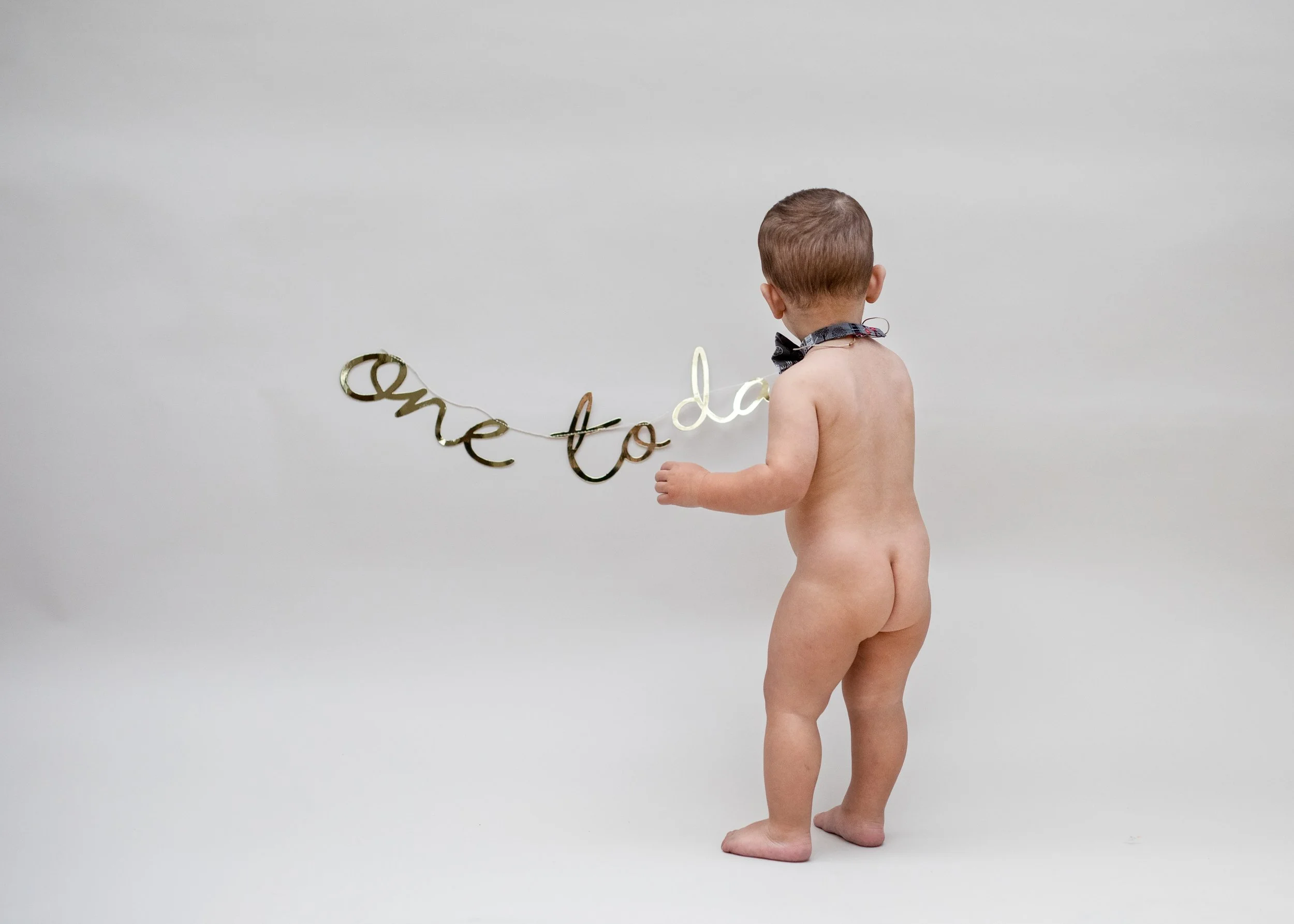
Here's Our Baby At Six Months. Here's Him At One. Look How Much He Changed.
Children change so quickly we barely notice it happening — until we look back. A milestone session is a way of stopping time on purpose, before the details blur into memory alone.
Children change so quickly.
In the middle of everything else — the feeding schedules, the sleepless nights, the sheer busyness of raising a small person — we don't really notice it happening. Their face shifts, week by week, in ways too gradual to catch in the moment. And then one day you look at a six-month photo and you almost don't recognise the baby you're holding now.
This is what a milestone session does, really. It stops time on purpose.
Here's our baby at six months. Here's him at one — look how much he's changed. Here he is at eighteen months, right after his first haircut. Without a photograph, all of that softens into a kind of blur. You remember that he changed, but not quite how, not quite when. The photograph holds what memory alone can't.
I think of it almost like a diary for a child — one you could genuinely tuck these images into, alongside the notes about first words and first steps. Years from now, you won't just remember that your baby grew. You'll be able to see it, stage by stage, and feel something close to disbelief at how fast it went.
I know it's tempting to think a phone camera does the job well enough. And in a sense, it can — for the everyday moments, the quick smile across the kitchen. There are even clever tools now that can dress up a phone photo into something that looks polished. But none of that replaces what a proper session gives you: real studio-quality light, the patience to actually get everyone looking the same direction at the same time, and — for cake smash sessions especially — a genuinely joyful, engineered moment that doesn't happen by accident.
Because that's the other thing about ordinary life with small children: it doesn't hand you many truly special moments on its own. Most days are just days. A cake smash session is one of the rare times you get to manufacture pure, uncomplicated delight — icing everywhere, a baby completely unbothered by mess, a room full of adults laughing — and have it properly documented, not just half-caught on someone's phone mid-chaos.
That's really what a milestone session is for. Not just a nice photo. A way of making sure that when you look back — and you will look back, more than you can imagine right now — there's something real there to see.
If this is the year you start marking the stages — six months, one year, eighteen months, or just a cake smash to celebrate the first birthday — I'd love to help you hold onto it properly. You can see how my milestone sessions work here →
Get In The Photo. Your Children Don't Care How You Look.
I have almost no photographs of myself with my own children. My children have told me this makes them sad. Here's what that taught me about the mothers and grandmothers who try to stay out of the frame — and why I always try to talk them back in.
I have almost no photographs of myself with my own children.
It's a strange thing to admit, for someone whose whole life is photography. I have thousands of images of other people's families — but when I go looking for pictures of me with mine, there's almost nothing. I was always the one behind the camera. Always the one saying "one more" to everyone else, never stepping in front to be part of it myself.
My children have told me this makes them sad. And they're right to feel that way. One day, a photograph of me — however I looked that day, whatever I was wearing, whether my hair was done — will be the only version of me they have left to hold onto.
I understand this from the other direction too. My own grandmother, and her mother before her, died before I had the chance to know them properly. What I have of them is a handful of old photographs my parents kept — creased, faded, some barely in focus. I am endlessly grateful those photographs exist at all. They're not just images. They're the only proof I have that these women were real, that I come from somewhere, that a whole life happened before mine did.
This is why, on almost every family session I photograph, I try to talk someone into the frame who doesn't want to be there.
It's nearly always a woman. A mother, a grandmother. "Not today," she'll say. "I look tired." "I haven't done my hair." "Just get the kids — I'll be in the next one." I understand this instinct completely — I've felt it myself, plenty of times, on the other side of my own camera. There's something deeply uncomfortable about being looked at when you don't feel your best.
But here's what I've learned, watching hundreds of families over eighteen years: the children don't see any of that. They don't notice the wrinkles you're worried about, or the concealer you didn't have time to apply, or the ten pounds you wish weren't there. None of it registers to them. What they see is their mother. Their grandmother. The person whose face they love more than any other face in the world, exactly as she is.
So I keep asking. Gently, but I keep asking. And almost every time, when someone finally steps in — reluctantly, still a little unsure — something shifts in the room. I've watched a grandmother go from arms crossed at the edge of the garden to laughing in the middle of a pile of grandchildren within a few minutes. I've watched mothers who spent the whole session directing everyone else finally sit down and let themselves be photographed too, and cry a little when they saw the images afterwards.
That photograph — the one that almost didn't happen — is very often the one a family tells me they love most.
If you're a mother, a grandmother, the one who always takes the pictures and never appears in them: I'd love to help change that, even just once. Not a perfectly posed, everyone-looking-at-the-camera kind of photograph, necessarily — just a real one, of your family, with you actually in it. Your children won't remember how you looked that day. They'll just be grateful you were there.
my family portrait sessions →
If this is the year you finally get in the photo — whether it's a full family session, or just you and your children, or three generations together — I'd love to talk it through. You can see how my sessions work and what's included here →
Newborn Photography in Summer — What Actually Helps
Summer in London can be glorious. It can also be 32 degrees in a flat with no air conditioning, a three-day-old baby who won't settle, and a very uncomfortable mother. I've worked through all of it — here's what I've learned.
Summer in London can be glorious. It can also be 32 degrees in a flat with no air conditioning, a three-day-old baby who won't settle, and a very uncomfortable mother at 40 weeks who has been hot since April. I've worked through all of it — here's what I've learned.
Newborns and heat
The first thing to know is that newborns are genuinely harder to settle in warm weather. This isn't just perception — small babies (and small children generally) sleep worse in the heat, the same way adults do. A baby who might drift off beautifully in October can be wide-eyed and unsettled in July, and that's not anyone's fault. It's just heat.
For indoor sessions in warm weather, my first move is to prepare the space before I arrive — opening everything that can be opened to create airflow, while being careful about draughts directly on the baby. If it's 30 degrees or above outside, I'll use light fabric on windows that get direct sun to reduce the temperature without blocking the light entirely. The goal is a room that feels calm, not a room that's been turned into a fridge.
Cool water nearby, light clothing, and patience are the main tools. Synthetic fabrics trap heat — natural fibres breathe better. And sometimes a session simply needs to move more slowly than usual, with more time between setups to let the baby resettle.
Outdoor sessions — timing is everything
For outdoor family sessions or any location work, I schedule around the heat rather than fighting it. In summer I strongly prefer early morning or after 7pm — the light is better at both ends of the day anyway, and the temperature is manageable. Midday and early afternoon in direct sun are not the time for a newborn, a heavily pregnant woman, or honestly anyone holding a camera.
For outdoor sessions with children and families: water, shade, light-coloured clothing, sandals or bare feet, and sunscreen are non-negotiable. I'll always flag the timing when we're booking, and if the forecast shows extreme heat on the day, we talk.
For pregnant mothers in summer
Late pregnancy in the heat is its own kind of endurance. By the third trimester, the body runs warm regardless of the weather — add July or August and it can feel genuinely overwhelming.
During my own pregnancy, I spent a significant amount of time at the pool. Not to exercise particularly, just to exist in water, which is the most effective way I know to feel like a human being again when you're heavily pregnant and it's 28 degrees outside. If you're in your third trimester this summer: find a pool, go often, don't feel like you need to justify it.
For maternity sessions in the heat, I work with what the body needs rather than against it. We take breaks. We choose the coolest part of the day. Lightweight, natural fabrics photograph beautifully and are far more comfortable than structured or synthetic options. If something isn't working physically, we adjust — the session adapts to you, not the other way around.
The honest version
Summer sessions are absolutely possible and often produce beautiful work — the light in early morning and evening is some of the best of the year. But they take more flexibility than sessions in milder weather, and I'd rather build that flexibility in from the start than pretend the heat isn't a factor.
If you're planning a session this summer and have questions about timing or what to expect, I'm happy to talk it through.
For newborn session details and pricing, you can find everything here →
What I Know About Maternity Portraits — Including the Ones I Took of Myself
There's an old saying about the shoemaker whose own children go barefoot. When I was pregnant, I was that shoemaker — and the only portraits I had of myself were the ones I took alone, figuring it out as I went.
There's an old expression about the shoemaker whose own children go barefoot — so busy making shoes for everyone else that there's never time to make a pair for home. When I was pregnant, that was me. I'd photographed other women through their pregnancies for years, and yet when it came to documenting my own, I ended up doing it myself: a self-portrait, figured out alone, camera on a timer, no one behind the lens but me.
It taught me something I think about every time I photograph another expectant mother now: how strange and vulnerable it is to be looked at right then, even when you're the one in control of the camera.
What working with pregnant women has taught me
Pregnant bodies are wonderfully unpredictable, and that unpredictability is the first thing I plan around. Physically, some women feel strong and capable right up to their due date; others are exhausted and sore by the second trimester, and that can shift week to week, sometimes day to day.
Hormones add another layer entirely. Mood can swing in the middle of a session — joy one moment, tears the next, not because anything is wrong, just because that's what pregnancy does to the nervous system. I've learned to read those shifts quickly and adjust the pace, rather than push through a shot list regardless of how someone is actually feeling in that moment.
Temperature matters more than people expect, too. Most pregnant women run hot, even in a cool room, so I keep that in mind with lighting, location, and how long I ask anyone to hold a pose.
And then there's the emotional range on any given day: some women feel shy or self-conscious in front of the camera, suddenly aware of a body that feels unfamiliar to them. Others arrive so deep in the experience of being pregnant that they forget the session is even happening and simply exist in front of the lens, completely themselves. Both are valid, and both need a slightly different kind of attention from me.
Why bodies lead, not poses
I have a set of poses I know work well, built from years of sessions — but I never treat them as fixed. If a position isn't comfortable, or a body simply won't move that way that day, we adjust. The body leads. I follow.
Beyond that, every woman wants something different from her maternity portraits. Some want flowing fabric and movement. Some want minimalism — clean lines, soft light, nothing extra. Others are drawn to something more boudoir in feeling, more intimate. I keep a collection of fabrics and dresses on hand for exactly this reason, and often something beautiful comes together spontaneously, mid-session, that wasn't part of the original plan at all.
So what does a good maternity session actually require?
Patience, mostly. A willingness to let go of a rigid plan the moment the day calls for something else. And an understanding that the woman in front of the camera is not a fixed subject — she's in the middle of one of the most physically and emotionally unpredictable chapters of her life, and the photographs should hold space for that, not flatten it into something tidier than it really is.
If you're expecting and thinking about maternity portraits, I'd love to talk through what feels right for you — fabric, minimalism, something more intimate, or simply whatever your body wants to do on the day.
Documentary or Posed? What That Choice Actually Means
People often ask me whether I do "posed" or "documentary" newborn photography, as if I have to choose one. Most of my sessions are actually both — just not in equal measure, and not by accident.
When people enquire about a newborn session, they often arrive with one of two words in mind: "posed" or "documentary." They've usually seen examples of each online and assume they need to pick a side. In practice, the distinction is less black-and-white than it looks — and most of what I deliver in a typical session is a deliberate mix of both.
What "posed" actually means
Posed newborn photography is the classical style most people picture first: a sleeping baby arranged in a bucket, wrapped in a particular way, lit with studio lighting against a clean backdrop. It takes skill, patience, and a calm baby — and it produces the kind of timeless, polished image that looks beautiful printed and framed for years to come.
This is the bulk of what I do. Around 70% of a typical newborn session with me is built around this classical, composed style.
What "documentary" actually means
Documentary newborn photography is the opposite instinct: no arranging, no studio setup, no asking anyone to hold still. It's photographing what's actually happening — a sibling peering into the moses basket, a parent mid-yawn at 3am, the baby's hand wrapped around a finger during a feed. Nothing is directed. It's reportage, not composition.
This makes up roughly the remaining 30% of most sessions — the quieter, in-between moments that happen naturally around the posed portraits.
Why I blend the two, rather than choosing one
Most families don't actually want a session that's entirely one or the other. They want the beautiful, classical portraits that make a stunning print for the wall — and they also want the real, unposed moments that show what early life with this particular baby was actually like. A purely posed session can feel a little stiff if it's all you get. A purely documentary session, while honest, often misses the timeless portrait families want to print and frame.
Blending both in the same session gives you the best of each: the polished portraits you'll treasure formally, and the candid ones that bring you straight back to how those first days actually felt.
When a fully documentary session makes more sense
For some families, a fully documentary approach is the better fit — particularly if posing isn't something the baby or parents want at all, or if the goal is purely to capture the atmosphere of those very first days rather than create formal portraits. That's why I also offer a dedicated Newborn Documentary session: three to four hours, entirely reportage-style, with no posed setups at all. It suits families who want their newborn days told as a story rather than composed as a portrait.
So which should you choose?
If you're not sure, that's completely normal — most people aren't. In our pre-session conversation, I'll ask about what matters most to you: the wall-worthy portrait, the honest in-between moments, or both. There's no wrong answer, and the blend can always shift based on what feels right for your family.
If you'd like to talk through which approach suits you, I'd love to hear from you.
If a fully documentary birth is more what you're after, you might also enjoy reading about a home birth I photographed that lasted hours → or what "natural" really means to me as a photographer →.
If you're deciding between a posed, documentary, or blended session, the full details of what to expect — and how to book — are on my newborn photography page →
If you're thinking about a newborn session — posed, documentary, or somewhere in between — I'd love to hear from you. Full details on how I work and pricing here →
What "Natural" Actually Means When I'm Photographing a Birth
People ask me what "natural" means in birth photography, as if it's a style I chose. It isn't a style. It's the absence of one.
People use the word "natural" a lot when they talk about birth photography, and I think most of them mean something different than I do.
For me, it has nothing to do with where the birth happens or whether there's an epidural. It's not a description of the birth at all — it's a description of what I do with my camera. Natural means I don't pose anyone. Ever. Not a hand placement, not a turn of the head, not "could you do that again, but slower." None of it.
Why I stopped directing, even a little
Early in my work, like most photographers, I'd occasionally nudge things — ask someone to move slightly into better light, suggest a moment be repeated for a cleaner frame. I don't do that in a birth room, and over time I stopped doing it almost anywhere in my documentary work too.
The reason is simple: the moment I ask someone to do something, it stops being theirs and starts being mine. A birth has its own rhythm, its own pace, its own collapses and surges of emotion. If I interrupt that to get a "better" angle, I've taken something true and replaced it with something performed. I'd rather have the real moment, slightly imperfect, than a beautiful recreation of it.
What this looks like in practice
It means I spend a lot of time simply watching. I don't bring a shot list. I don't have a sequence I'm trying to capture in order. I read the room — when to lift the camera, when to lower it, when my presence needs to shrink to almost nothing.
It also means I work with whatever light and whatever space I'm given. No flash, no reflectors, no asking anyone to move closer to the window. If the room is dim, the room is dim — that dimness is part of what actually happened, and softening or brightening it afterward would be its own kind of dishonesty.
Why this matters more in birth than almost anywhere else
A birth is not a moment people can perform twice. There's no "let's try that again" when a baby is being born. So if a photographer is the kind who needs to direct, who needs control over a frame, they're working against the one thing that makes birth photography worth doing at all: it's real, and it happened exactly once, exactly like that.
I'd rather hand someone a slightly messier photograph that's completely true than a polished one that quietly edits the truth out.
If that's the kind of birth photography you're looking for — quiet, unposed, and entirely yours — I'd love to hear from you.
If you'd like to read more about specific experiences — including [a caesarean birth I photographed and lived through myself →] and [a home birth that lasted hours →] — those stories are part of this same approach.
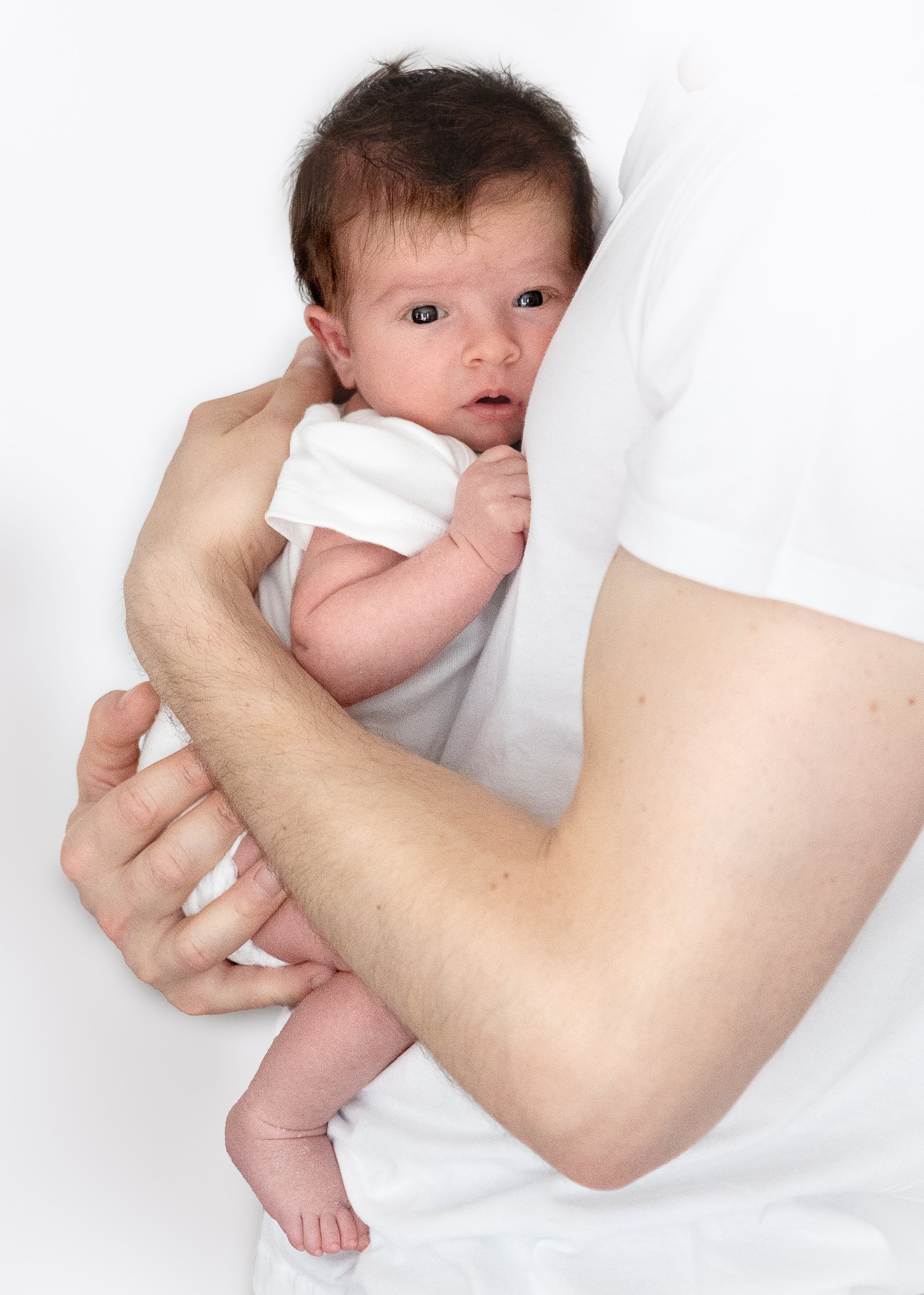
The Photograph I Always Want to Take
In those first days at home, there is nothing more important than the person beside her. Not always words. Sometimes just a look.
There is one photograph I always want to take during a newborn session.
Not the baby curled and sleeping.
Not the mother gazing down.
The hands.
A father's hands holding a newborn — enormous and careful and completely certain — while everything else in the room is uncertain.
Those first days at home with a new baby are unlike anything else.
A new mother who doesn't yet know what to do with this small person she has been handed.
Who is exhausted in a way she has never been exhausted before.
Who hasn't slept.
Who worries.
Who wants, more than anything, to be the best mother she can possibly be.
Whose body hurts.
Whose whole self is rearranging.
Who sometimes feels completely alone in the universe — even in a room full of people.
Whose own parents may be far away.
Who has only just stopped being someone's child herself — and is now responsible for another life entirely.
In those moments, there is nothing more important than the person beside her.
Not always words.
Sometimes just a look.
A steadiness.
An energy that says: I've got you. We've got this.
That is enough to move mountains.
And when I photograph a father holding his newborn — those huge hands, that quiet certainty — I am photographing that too.
The thing that doesn't always get said.
But that makes everything possible.
If you're expecting a baby and thinking about a newborn session in London or Bromley, I'd love to hear from you. See full collections at investment or get in touch.
When Is the Best Time to Book a Newborn Photographer in London
Most people ask me this question somewhere around week twenty of their pregnancy.
Which is, honestly, exactly the right time.
But let me explain why — because the answer is a little more nuanced than "book early."
The window that matters most
Newborn photography works best in the first six weeks of life.
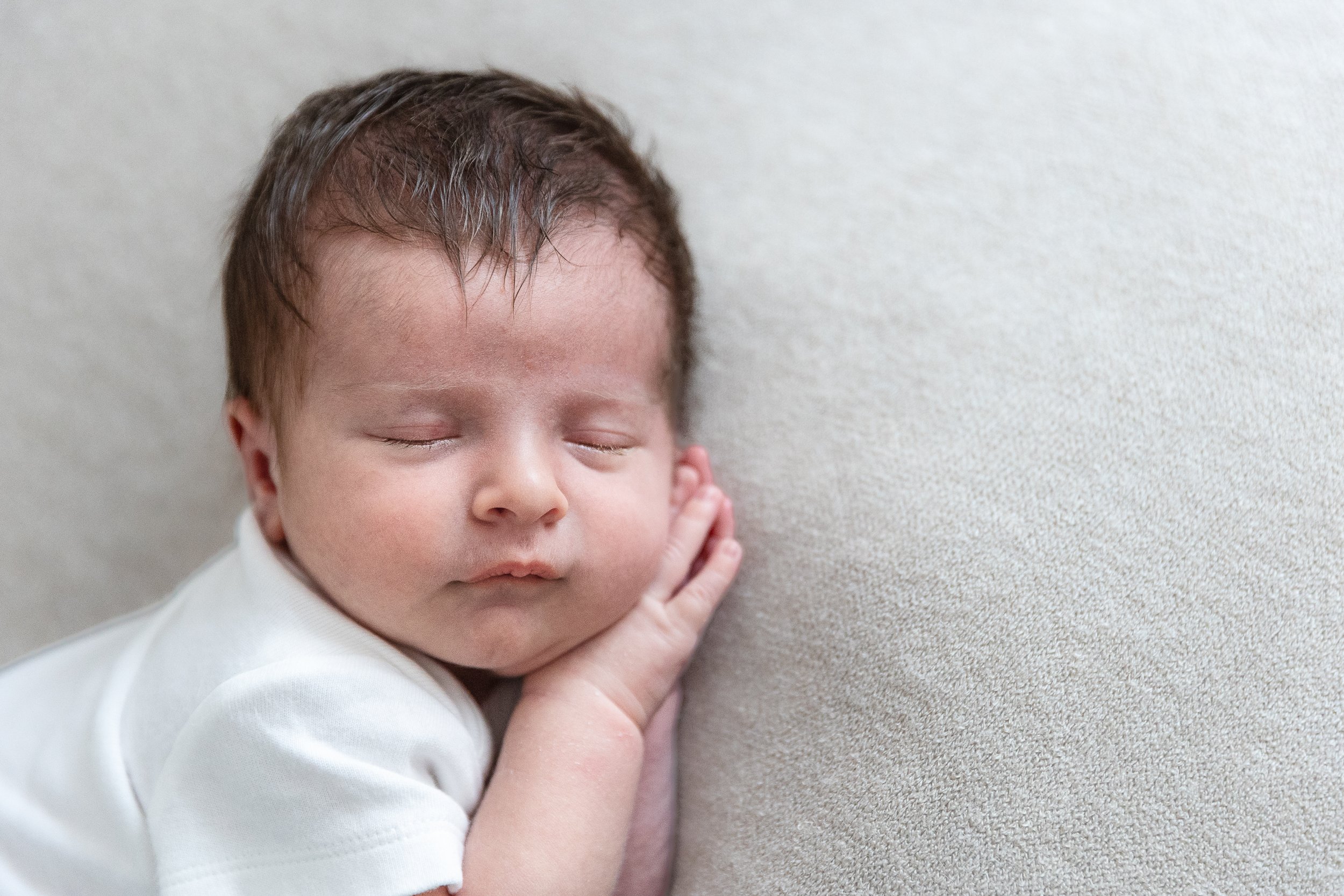
Within that window, the first two weeks are the gentlest. Babies sleep more deeply, curl more naturally, and settle more easily into the classic poses that make newborn portraits so timeless — hands tucked under chin, wrapped and peaceful, tiny and new.
After two weeks, babies become more alert. More awake. More opinionated.
The photographs are still beautiful — just different. More personality. Less curl.
So if you want the classic posed newborn portraits, the earlier the better. If you're drawn to a more awake, expressive style — there's more flexibility.
Either way, the session needs to happen in those first weeks. And those weeks arrive faster than anyone expects.
Why London families book during pregnancy
A good newborn photographer in London — one who takes a limited number of sessions each month, who comes to your home, who gives your family their full attention — books up.
Not weeks in advance. Months.
I take a limited number of newborn sessions each month across London and Bromley. In busy periods — particularly spring and the weeks before Christmas — I'm sometimes fully booked two to three months ahead.
If you contact me when your baby is already here, I will always try to help. But I cannot always guarantee availability in that first precious window.
The families who get the dates they want are almost always the ones who reached out during their second trimester.
How booking actually works
When you contact me during pregnancy, I don't ask you to commit to a fixed date.
We hold a provisional date around five to ten days after your due date — and we keep it flexible. If your baby arrives early, we move it. If your baby arrives late, we move it. If you need an extra week to feel ready, we move it.
Nothing is fixed except the intention.
The session fee is confirmed once your baby arrives and we set the final date together.
If your baby is already here
Please still get in touch.
I photograph newborns up to six weeks old — sometimes a little beyond, when the timing works. An older newborn has something a younger one doesn't — more expression, more presence, more of themselves already showing through.
The photographs are always worth taking.
Just reach out as soon as you can, so we have the best chance of finding the right date.
A quiet note on waiting
I understand why families sometimes wait.
You want to be sure everything is going well with the pregnancy. You don't want to plan too far ahead. It feels strange to be organising photographs before the baby is even born.
All of that makes complete sense.
But those first weeks pass very quickly. Faster than anyone warns you.
One morning you look at your baby and realise they no longer look the way they did on day three. The curl is a little less. The newness is already softening.
That's not a reason to panic. It's just a reason to reach out when you feel ready — and not to leave it too long.
If you're thinking about newborn photography in London or Bromley, I'd love to hear from you. You can see full collections on my investment page or simply get in touch — I'm always happy to answer questions, whatever stage you're at.