
What "Natural" Actually Means When I'm Photographing a Birth
People ask me what "natural" means in birth photography, as if it's a style I chose. It isn't a style. It's the absence of one.
People use the word "natural" a lot when they talk about birth photography, and I think most of them mean something different than I do.
For me, it has nothing to do with where the birth happens or whether there's an epidural. It's not a description of the birth at all — it's a description of what I do with my camera. Natural means I don't pose anyone. Ever. Not a hand placement, not a turn of the head, not "could you do that again, but slower." None of it.
Why I stopped directing, even a little
Early in my work, like most photographers, I'd occasionally nudge things — ask someone to move slightly into better light, suggest a moment be repeated for a cleaner frame. I don't do that in a birth room, and over time I stopped doing it almost anywhere in my documentary work too.
The reason is simple: the moment I ask someone to do something, it stops being theirs and starts being mine. A birth has its own rhythm, its own pace, its own collapses and surges of emotion. If I interrupt that to get a "better" angle, I've taken something true and replaced it with something performed. I'd rather have the real moment, slightly imperfect, than a beautiful recreation of it.
What this looks like in practice
It means I spend a lot of time simply watching. I don't bring a shot list. I don't have a sequence I'm trying to capture in order. I read the room — when to lift the camera, when to lower it, when my presence needs to shrink to almost nothing.
It also means I work with whatever light and whatever space I'm given. No flash, no reflectors, no asking anyone to move closer to the window. If the room is dim, the room is dim — that dimness is part of what actually happened, and softening or brightening it afterward would be its own kind of dishonesty.
Why this matters more in birth than almost anywhere else
A birth is not a moment people can perform twice. There's no "let's try that again" when a baby is being born. So if a photographer is the kind who needs to direct, who needs control over a frame, they're working against the one thing that makes birth photography worth doing at all: it's real, and it happened exactly once, exactly like that.
I'd rather hand someone a slightly messier photograph that's completely true than a polished one that quietly edits the truth out.
If that's the kind of birth photography you're looking for — quiet, unposed, and entirely yours — I'd love to hear from you.
If you'd like to read more about specific experiences — including [a caesarean birth I photographed and lived through myself →] and [a home birth that lasted hours →] — those stories are part of this same approach.
What I Know About Home Birth — From Both Sides of the Camera
I decided, long before I knew anything about photography, that I would never give birth in a hospital. Years later, I found myself on the other side of that decision — photographing someone else's home birth, feeling every hour of it with her.
I was twenty-two. It was the late nineties, and where I lived, there were no antenatal classes, no birth preparation courses, none of the structure that exists now to walk a first-time mother through what's coming. There was just a decision I made early on: I would not give birth in a hospital.
So I did the only thing I knew how to do. I bought a book on birth and read it properly — not skimming, but studying it the way you study something that frightens you a little. By the time the day came, I felt like I already knew what was happening to me, even though it was my first time and I was so young.
The birth itself was easy. My husband was beside me the whole time, and I remember the strangest, funniest detail more clearly than almost anything else: we had spent the entire pregnancy certain we were having a boy. We even had the name picked out. So when she finally arrived and he lifted her up, there was this beat of pure confusion before we both realised — it's a girl. We laughed. After everything, that was the moment that broke the tension completely.
I think that experience shaped how I photograph birth more than anything I've learned since.
Photographing someone else's home birth
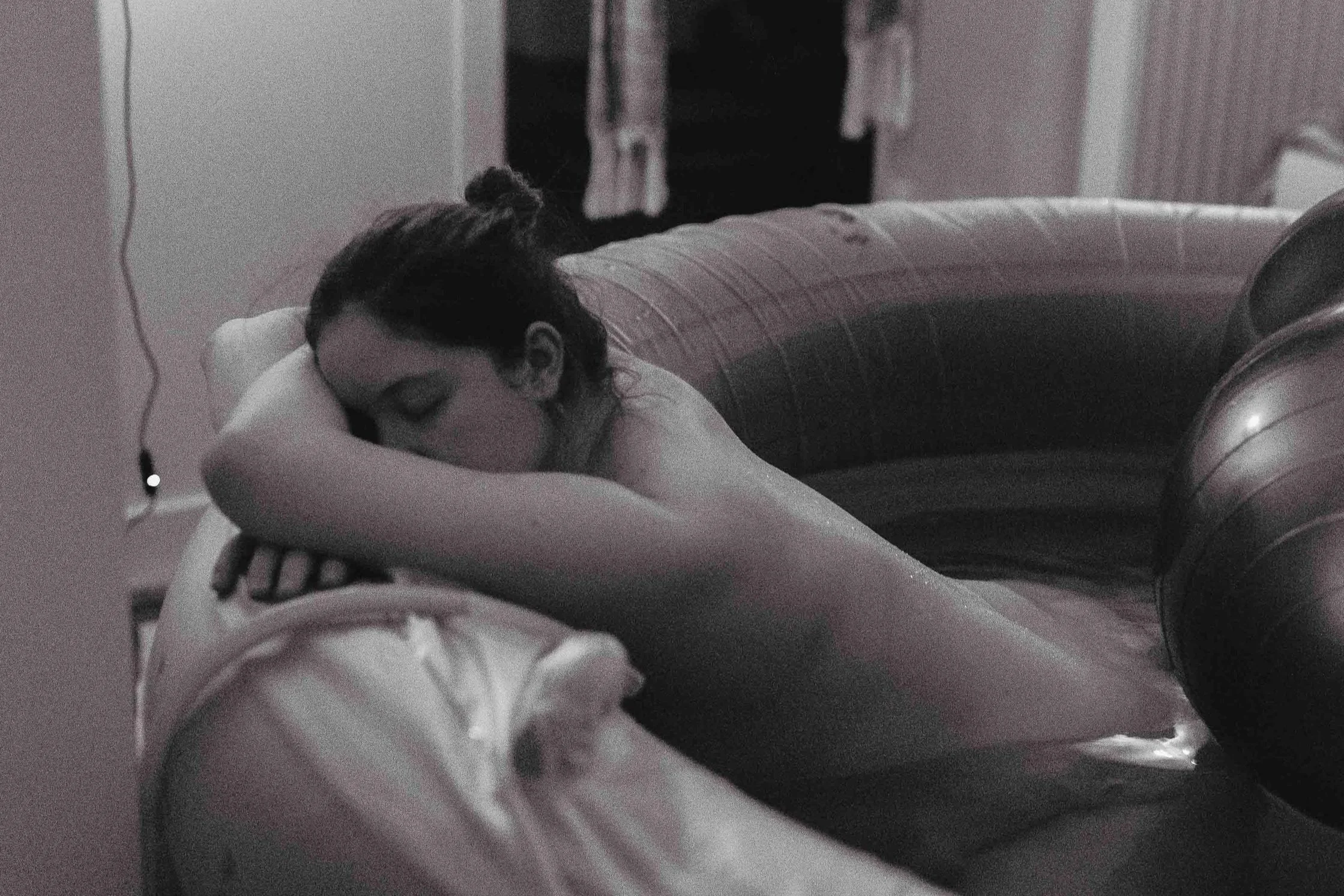
Years later, I found myself in a client's home for a birth that was nothing like a quick story. It was long. Hours and hours of it. And unlike a hospital, where you might have some control over light, here I worked with whatever was actually in the room — no setup, no adjustments, because the only thing that mattered was that the mother felt comfortable, not watched.
I made myself as invisible as I could. I didn't direct, didn't ask anyone to move or pause. I just stayed close and quiet and ready.
What I didn't expect was how much I would feel. I had been through this myself, so every stage of it landed somewhere in me — I wasn't just observing, I was recognising. That made it harder in a way I hadn't anticipated, but it also meant I understood exactly what mattered enough to capture and what didn't. Because the day was long, I had time to see so much: the early hours, the shift into harder labour, and finally the moment everyone in the room had been waiting for.
Why I still believe in this work
A home birth has no schedule I can plan around and no lighting I can control. It asks a photographer to disappear into the background and to trust that the story will tell itself, in its own time, exactly as it happened.
That's the only kind of birth photography I know how to do, really — because it's the only kind I've ever lived through myself.
If you're planning a home birth in London and want it photographed honestly, without posing or performance, I'd love to talk about it.
If you're planning a home birth in London and are looking for a home birth photographer who won't pose or direct you — just watch closely and stay out of the way — I'd love to talk about it.
That's the only kind of birth photography I know how to do — without posing, without direction, just watching closely. I've written more about what that actually means here: What "Natural" Actually Means When I'm Photographing a Birth →