
Physiotherapy, Comedy, and Night-Shift Nursing — With a Camera Somewhere in the Middle
People imagine I turn up, click a button, and leave. What actually happens is closer to physiotherapy, comedy, and night-shift nursing — with a camera somewhere in the middle of it.
People imagine newborn photography looks like this: I arrive, I take some pictures of a sleeping baby, I leave. Simple.
Eighteen years in, I can tell you it is not that. Not even close.
Start with the equipment. Every session means carrying a full studio into someone's home — lighting, backdrops, wraps, props, all of it — up stairs, through narrow hallways, into houses that were never designed with a photographer's kit in mind. I've done this so many times now that I've given myself a frozen shoulder and a back that has strong opinions about certain movements. I've also, somewhere along the way, developed the arms of someone who lifts weights for a living. Nobody warns you about that part when you fall in love with newborn photography.
Then there's the baby. A newborn session doesn't run on my schedule, or the parents' schedule — it runs on a schedule that exists nowhere except inside a very small, very new person who has no interest in cooperating with anyone's plans. I've spent entire sessions holding a single pose, perfectly still, waiting for one genuine smile to cross a sleeping face. I've changed more nappies than I could count, rocked babies for what felt like hours, learned to read the tiniest pre-cry signals before they turn into an actual cry. People call me the baby whisperer, and I've come to accept it as an actual job requirement, not a compliment.
Older siblings need something entirely different from me — not patience with stillness, but the opposite. I turn into whatever kind of clown gets a shy five-year-old to trust me enough to be photographed looking like themselves, not like someone being told to smile for a camera. That relationship has to be built in minutes, not months.
And then there are the parents — often exhausted beyond words, running on almost no sleep, sometimes anxious in ways they can't quite name. Part of what I do in those hours has nothing to do with a camera at all. It's noticing things. I've caught small signs in a baby more times than I can count and gently flagged them — not as a doctor, but as someone who has now watched well over a thousand newborns closely enough to know when something is worth a second look.
By the time I leave, I'm usually exhausted and quietly thrilled, in that order. But the work isn't finished — it's barely begun. Every piece of fabric I brought gets washed before it touches another baby. Sneak peek images get edited that same day or the next, because I know parents are waiting, checking their phones, wanting one image before the full gallery arrives. Then the real editing starts — the long, unhurried part nobody sees, where a session slowly becomes the images you'll actually keep.
So when people picture newborn photography as "turn up, press a button, leave" — I understand why. From the outside, that's exactly what it looks like. From the inside, it's part physiotherapy, part comedy, part night-shift nursing, part quiet pattern-recognition — and somewhere in the middle of all of that, a camera.
I wouldn't trade it. But I thought you should know what it actually takes.
If you'd like to know more about how a session works, or see the full range of collections, everything is here →
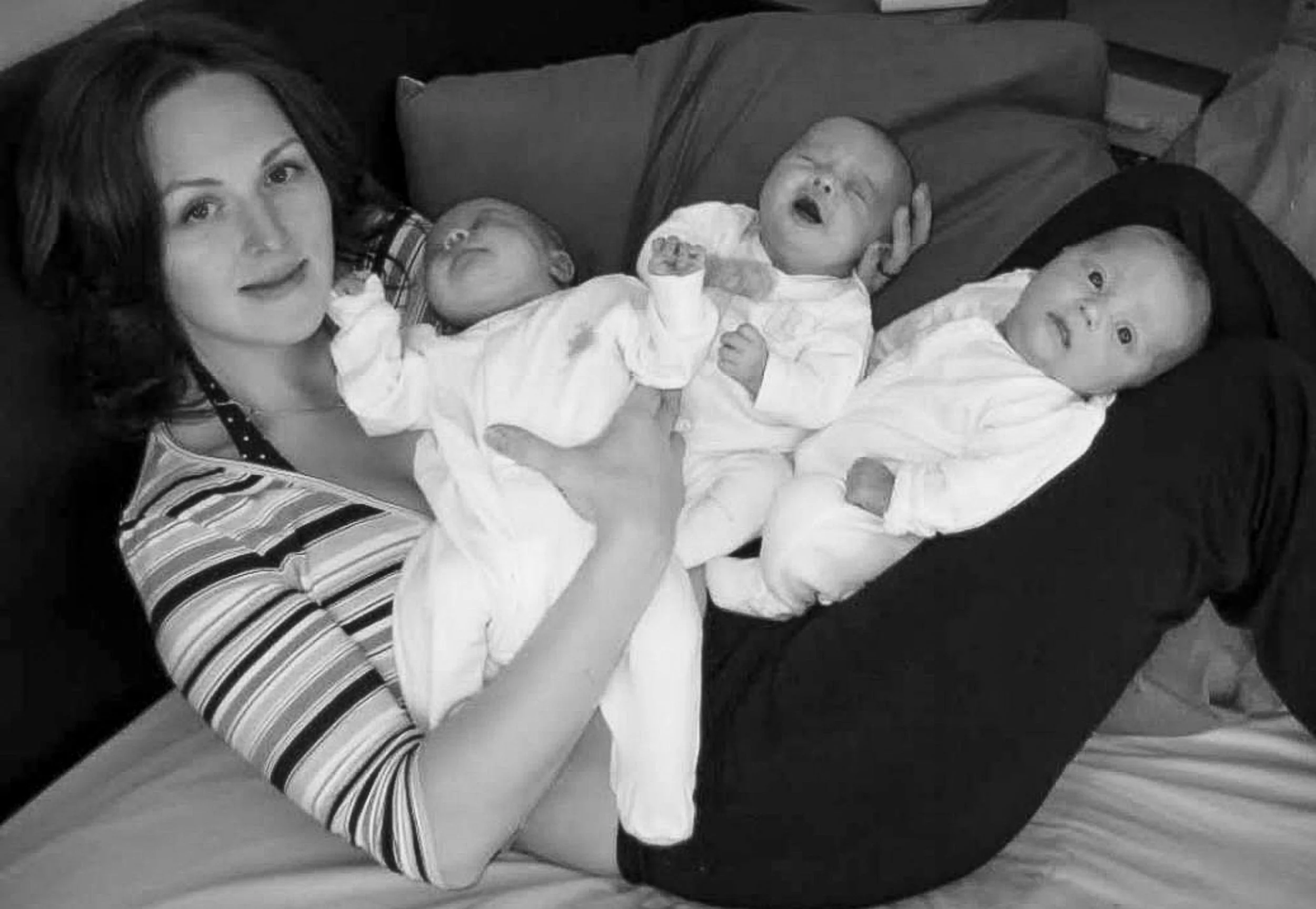
I Once Said I Wanted Five Children
I thought two children were enough. Then I had triplets.
Sometimes I think it’s a very strange question — and at the same time, a very important one.
Why do we actually want children?
When I was little, my mum once asked me:
“Kate, how many children do you want?”
And I answered:
“Five.”
To this day I have no idea where that number came from. Nobody in my family had lots of children. Maybe some distant great-grandmothers, but that’s about it.
Then I had two children and honestly thought:
“That’s it. Absolutely enough. No more.”
A few years later, I suddenly wanted another baby.
And instead, I had triplets.
I still remember my mum laughing:
“Well… dreams do come true. You wanted five.”
When I photograph newborns now, parents often imagine that newborn photographers must have beautifully documented every second of their own children’s lives.
Perfect little albums.
Perfect sleepy portraits.
Perfect memories carefully preserved from day one.
But my own children sometimes ask me:
“Mum, you’re literally a photographer… why do we barely have any photos from when we were babies?”
And I always answer honestly:
Because I was exhausted.
Completely exhausted.
When you have small children — especially several at once — sometimes you are not creating memories.
Sometimes you are simply surviving between feeds, laundry, tiny socks, sleepless nights, and cold coffee you forgot to drink.
And honestly, that is one of the reasons I love in-home newborn sessions so much.
Because you do not need to pack bags.
You do not need to drive anywhere.
You do not need to pretend you are functioning perfectly.
Sometimes parents simply hand me the baby… and go back to sleep.
I’m not joking.
And I completely understand it.
Maybe that’s also why these photographs matter so much.
Not because life looks perfect in them.
But because one day the whole period starts feeling almost unreal.
Like some strange beautiful fog you lived through half-asleep.
Tiny fingers.
Milk bottles at 3am.
Warm sleepy weight on your chest.
The sound of breathing next to you in the dark.
You are unbelievably tired.
And somehow, at the very same time, deeply happy.
So why do we have children?
Maybe to live a bigger life than the one we could live alone.
Maybe to watch another human becoming themselves right in front of you.
Maybe to heal things quietly without even noticing.
Maybe to experience a kind of love that completely rearranges your understanding of time, fear, exhaustion, and joy.
Or maybe simply to lie there one day, surrounded by your children, and suddenly realise:
this is life.